You Are Welcome Here
Sanctuary in Faith and Community
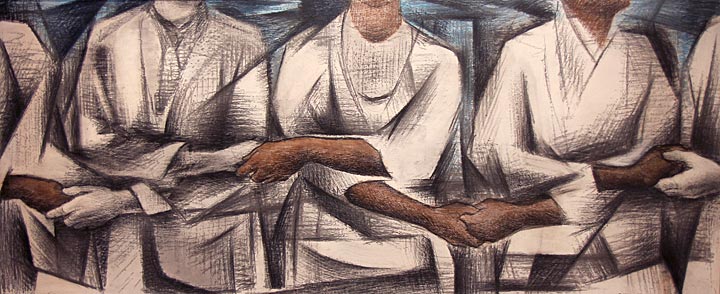 |
| “The Chain,” Edward Biberman (1940) |
I have no special knowledge or training, but like all of us in this community*, I’m in search of spiritual fellowship and deepening of my faith. And as I tell my students all the time, the first step to action is taking thought and putting it into words.
So I just turned 50 and perhaps in consideration of that halfway mark to a century, I’ve been looking up and down the long river of my life. Perhaps it explains why, as I was reading a few weeks ago, my mind was pulled back to my childhood — to a very particular memory — a memory of what I can only describe as my first religious experience.
What I had been reading about was how the philosopher Ludwig Wittgenstein, struggling under the misery and despair of World War I, fighting in a campaign that saw nearly 600,000 deaths, had found a book that he said, “virtually kept me alive.” In foxholes and trenches, under fire and in moments of quiet, he read it and re-read it. It became a sanctuary for him, protection from the evils around him. This book, which he always kept at hand, was a translation and synthesis of the four canonical Gospels, written by the famed Russian novelist Leo Tolstoy, a text whose title is usually translated from the Russian as The Gospel in Brief.
That book, it turned out, had also been a salvation for its author. In the late 1870s, after publishing Anna Karenina and War and Peace, Tolstoy entered a period a profound crisis. What was life? Why bother? He found no help from his supposedly wise friends who told him that we are nothing more than “an accidental chain of atoms, that there is no purpose in life and life itself is evil.” Tolstoy became despondent, even suicidal. And like Wittgenstein, he too, found solace in a book. In his case, the New Testament. Tolstoy wanted to get as close as he could to Jesus’ own teaching and so eschewed everything but the four Gospels. He returned to the ancient Greek texts, translating but also stripping them of ritual, dogmatism, and the supernatural. Gone were the miracles, which for Tolstoy existed merely to convince later readers of “the divinity of Jesus,” something Tolstoy found irrelevant. His singular focus was on what he considered the essential teachings.
This sense of the transformative power of text was what doubtless triggered my trip down memory lane.
As a young child, I was small and anxious, so much more concerned with the needs and thoughts of others, that I often failed to care for myself. I made mistakes and was filled with paralyzing regret. As I entered my teens it could be suffocating.
And then, one day when I was 14, I chanced upon a funny little book, Benjamin Hoff’s The Tao of Pooh, which introduced me — and so many others — to Taoism through two of its greatest sages, Lao Tzu and Chuang Tzu, and Hoff’s funny and smart re-reading of A.A. Milne’s Winnie the Pooh stories.
I was about halfway through the book when one day I found myself standing in the kitchen with my mother, full of regret over some failure or missed opportunity — honestly I can’t remember what it was, but my mother was upset and I was twisted up inside. Suddenly time slowed as I flashed upon one of Chuang- Tzu’s parables from the book, a story called “The Gorge of Lü.” It goes like this:
At the Gorge of Lü, the great waterfall plunges for thousands of feet, its spray visible for miles. In the churning waters below, no living creature can be seen.
One day, Confucius was standing at a distance from the pool’s edge, when he saw an old man being tossed about in the turbulent water. He called to his disciples, and together they ran to rescue the victim. But by the time they reached the water, the old man had climbed out onto the bank and was walking along, singing to himself.
Confucius hurried up to him. “You would have to be a ghost to survive that,” he said, “but you seem to be a man, instead. What secret power do you have?”
“Nothing special,” the old man replied. “I began to learn while very young and grew up practicing it. Now I am certain of success. I go down with the water and come up with the water. I follow it and forget myself. I survive because I don’t struggle against the water’s superior power. That’s all.”
I looked at my mother, then closed my eyes and took a deep breath — “go down with the water and come up with the water.” I opened my eyes and released the swirl of guilt and grief within myself with a slow breath out. “I made a mistake,” I said, nothing more. My mother stood in shock — maybe even dismay — because I had broken our ritual of Jewish guilt and over-intellectualization and replaced it with a new way of being myself. Living with guilt and regret was corrosive to my being and I sought thereafter to be free of them.
○ ○ ○
These thoughts, amplified amidst the dispiriting politics of our last few years, brought our family to this congregation. And as we sat down for the first time and heard the invocation, I felt lifted up.
Come, come, whoever you are — you are welcome here! With these words, I began this unsteady journey.
This is the first congregation I have ever joined. And it’s been both joyous and disquieting. And the longer I’m here, among all of you, the more I’ve been thinking, talking, reading, and exploring what it means to belong.
I have found some inspiration in a sermon offered by Alex Kapitan, LGBTQ and Multicultural Programs Administrator, at the UUA. “What would it be like,” Kapitan asks, “if you could trust, unequivocally, that you were valued here for the pieces of yourself that make you feel different, not despite those pieces. That in this space there was nothing about you that could make people reverse their welcome or reject you from the circle of belonging? When I think about Beloved Community, this is what I think about and long for. A community of radical welcome, where each person affirms the piece of the divine that lives in themself and in every other being. Where we can hold each other in all of our messiness and all of our brokenness, where love and compassion reign supreme. Where each of us fully, completely, belongs.”
These words got me thinking about the idea of sanctuary. Sanctuary, in its original definition, comes to us from Latin, meaning a sacred or holy place. Only much later, did this sacredness come to be in service of protecting the fugitive, the refugee, the oppressed. I think that for most of us, sanctuary embodies these two together. But this space that we’re in, stunning as it is — in it’s beauty, it’s light, it’s warmth — is not, for me, what is sacred. That, I reserve for you — for us. We, whether gathered here or elsewhere, are what is sacred. And we are sacred because we imagine a world where all belong. We are the sanctuary.
But it isn’t as easy as saying it or thinking it. It has to be built. It takes work and is not infrequently discomforting. In fact, if it’s not work, if there is no discomfort, I’m not sure we’re trying hard enough.
○ ○ ○
A beautiful and painful essay by the writer Eula Biss helps me give word to this work and this discomfort in the service of a shared sanctuary. Her essay, “White Debt,” responds, in part, to the poet Claudia Rankine’s essay, “The Condition of Black Life is One of Mourning,” written just after the Charleston church massacre. Biss writes:
Sitting with Rankine’s essay in front of me, I asked myself what the condition of white life might be. I wrote “complacence” on a blank page. Hearing the term “white supremacist” in the wake of that shooting had given me another occasion to wonder whether white supremacists are any more dangerous than regular white people, who tend to enjoy supremacy without believing in it. After staring at “complacence” for quite a long time, I looked it up and discovered that it didn’t mean exactly what I thought it meant. “A feeling of smug or uncritical satisfaction with oneself or one’s achievements” might be an apt description of the dominant white attitude, but that’s more active than what I had in mind. I thought “complacence” meant sitting there in your house, neither smug nor satisfied, just lost in the illusion of ownership…. I erased “complacence” and wrote “complicity.” I erased it. “Debt,“ I wrote. Then, “forgotten debt.”
 |
| ProtoplasmaKid / Wikimedia Commons / CC-BY-SA 4 |
Whiteness, is costing me my community. It is the wedge driven between me and my neighbors, between me and other mothers, between me and other workers. I know there’s more too. I have written and erased a hundred sentences here, trying and failing to articulate something that I can sense but not yet speak. Like a bad loan, the kind in which the payments increase over time, the price of whiteness remains hidden behind its promises.To my historian’s ear — perhaps even more to my ear as a white person — there is something powerful, lovely, yet deeply melancholy in Biss’ words. As I read them I feel like I am enveloped in water, slow-moving, uncertain, “trying and failing,” as she says, “to articulate something that I can sense but not yet speak.”
Biss’ words bring me back to the Gorge of Lü and the old man who survives its treacherous rocks, going down with the water and coming up with the water. How does he survive? He smiled at Confucius and said, “I follow the water and forget myself. I survive because I don’t struggle against the water’s superior power.” These Taoist teaching of my youth remain vital to my inner balance, to my personal sanctuary, just as The Gospel in Brief served Tolstoy and Wittgenstein in their hours of need. But my hour of need is not enough, my sanctuary is not enough. Living with regret was corrosive to my being, but even more so is inaction.
 |
| AK Rockefeller / James Baldwin / CC BY-SA 2.0 |
On the one hand white people can scarcely dare to open a dialogue which must, if it is honest, become a personal confession — a cry for help and healing, which is, really, I think, the basis of all dialogues — and, on the other hand, the black man can scarcely dare to open a dialogue which must, if it is honest, become a personal confession which, fatally, contains an accusation. And yet, if neither of us cannot do this, each of us will perish in those traps in which we have been struggling for so long.For us to be a sanctuary — a sacred community of refuge — means truly reckoning with both ourselves and those around us.
○ ○ ○
Take a few moments to think about what this means. What does it mean for you to be truly welcome here? What does it mean for us to truly welcome others? What it is for us to be sacred and for us to provide refuge?
Now, if you would, I’d ask that you take the hands of those next to or around you into your own. Hold them and close your eyes. Are the hands warm or cold? Soft or rough? Small or large? Think about the people around you and the sacredness that we form together here.
If you come here with an open mind, a loving heart, and willing hands, then you are indeed welcome here!
Open your eyes and see one another.
I’d like to finish by returning to the reading I shared earlier today, Rev. Angela Herrera’s meditation poem, “All That You Need Lies Within You.” In the last stanza she writes:
We need peace. We need love. We need to let go of regret. But, of course, that peace within — that peace of self — is only the necessary start to action.All that you need
for a deep and comforting peace to grow
lies within you.
So may it be. Amen.Once it is in your heart
let it spread into your life
let it pour from your life into the world –
and once it is in the world,
let it shine upon all beings.
○ ○ ○
*These words first spoken at First Unitarian Universalist Church of New Orleans, October 14, 2018.
Comments
Post a Comment